


What to see in Bocagrande: the 1945 Hotel Caribe, built on the strip where Charles Lindbergh landed in 1928; an 18th-century undersea wall and a sunken Spanish fort off its beaches; Cartagena’s tallest skyscrapers; the Perpetuo Socorro church; and the El Laguito lagoon. You can walk it all in two to three hours.
Last updated: October 15, 2026. Historical facts, addresses and roadwork status checked against the sources listed at the end; confirm opening times before you go.
Quick facts
- Location: a peninsula southwest of the Old Town, between the Caribbean and the bay; El Laguito sits at the tip and Castillogrande on the south side.
- Getting there: 5-10 minutes by taxi from the Old Town (2026 minimum fare: COP 12,250, about USD 3.80) or Transcaribe bus (COP 3,900, about USD 1.20).
- Best time: 7-10 a.m. to walk before the heat; El Laguito at sunset, around 5:30 p.m.
- Budget: the route is free (everything is visible from the street); add your taxi and a juice or coffee, COP 10,000-20,000 (USD 3-6).
- Time needed: 2-3 hours on foot with stops.
Approximate conversion: USD 1 ≈ COP 3,200 (official rate of 3,218.75 on October 9, 2026, per Portafolio).
Why is Bocagrande worth a second look?
Most visitors come to Bocagrande for the beach and the hotels and leave thinking it is Cartagena’s neighborhood “without history.” It’s the other way around: beneath its streets and off its sand lie four centuries of layers. One of the bay’s first forts stood here; Crown engineers sank a wall into the sea here to shut the door on pirates; the world’s most famous aviator landed here; and the city’s first big hotel opened here. The skyscrapers are just the latest chapter.
The difference from the Old Town is that Bocagrande’s history isn’t in museums or on plaques: you need to know where to look. This guide gives you that map, with verified facts and a walking route to see it all in one morning.
What is Bocagrande’s history in key dates?
| Year | What happened | What remains today |
|---|---|---|
| 1567 | Governor Pedro de Acuña orders the San Matías fort at Punta Icacos, next to today’s El Laguito. | Ruins about 6 m underwater |
| 1626-1628 | A royal decree orders the fort dismantled. | Stones on the seabed |
| 1768-1778 | Antonio de Arévalo builds the undersea wall that closes the bay’s “big mouth.” | The wall is still there |
| 1928 | Charles Lindbergh lands on Bocagrande’s makeshift airstrip. | The Hotel Caribe grounds |
| 1945 | The Hotel Caribe opens (December 30). | Still operating |
| 1956 | The Bocagrande Hospital is inaugurated. | Photos in the UTB archive |
| 2010-2021 | Towers over 150 m arrive: Grand Bay, Estelar, Hyatt, Portomarine. | Today’s skyline |
| 2025 | Colombia’s maritime authority (Dimar) publishes the identification of the sunken San Matías fort. | Underwater heritage under study |
Which buildings and landmarks in Bocagrande should I see?
Hotel Caribe: the building that invented beach tourism in Cartagena
It opened on December 30, 1945, and is considered the first large hotel built in Cartagena. Cuban architect Manuel Carrerá gave it a neocolonial look: a central tower, arches and tile roofs facing the Caribbean from Carrera 1 #2-87. According to El Colombiano, before construction the land was mangrove and a rough airstrip where Charles Lindbergh landed the Spirit of St. Louis in 1928. The complex covers about 35,000 m², with some 5,000 m² of gardens.
Those gardens are famous for their residents: in 2011 the paper counted more than 30 sloths plus deer, macaws, monkeys and iguanas, kept under a permit from the environmental authority. The hotel hosted the 1947 National Beauty Pageant, and the Cartagena Film Festival was born here in 1960. Today it operates as Hotel Caribe by Faranda Grand and was renovated in 2025. You can admire the facade for free from Carrera 1; to enter the gardens, ask at reception. See photos of the place.
The undersea wall: the rampart you can’t see
Bocagrande is named after the “boca grande,” the wide natural channel between the peninsula and Tierrabomba island. After a shipwreck in 1640 a sandbar formed; when the channel reopened, the Crown feared enemy ships would sail straight in. Under a royal order of 1764, military engineer Antonio de Arévalo built a breakwater between 1768 and 1778: four lines of piles driven into the seabed, with boxes filled with three layers of stone.
It worked: ever since, ships have entered through Bocachica. It also had an unexpected side effect: sand piled up against it and the peninsula grew by about 40 hectares, according to the Dimar study reported by El Universal. There’s no viewpoint, since it lies underwater between El Laguito and Tierrabomba. Look toward the island from the tip of El Laguito and picture a 250-year-old wall beneath the waves.
San Matías fort: the sunken castle off El Laguito
Long before the wall, in 1567, Governor Pedro de Acuña had the San Matías fort built at Punta Icacos, southwest of today’s El Laguito. It was rebuilt in 1602 and dismantled by royal order from 1626. For centuries it was considered lost, until Dimar’s Underwater Cultural Heritage research group, surveying the breakwater with multibeam sonar since 2014, identified its stones about six meters down. The finding was published in 2025 in the Journal of Maritime Archaeology. It can’t be visited, but it is Bocagrande’s oldest monument.
The skyscrapers: the tallest skyline on Colombia’s Caribbean coast
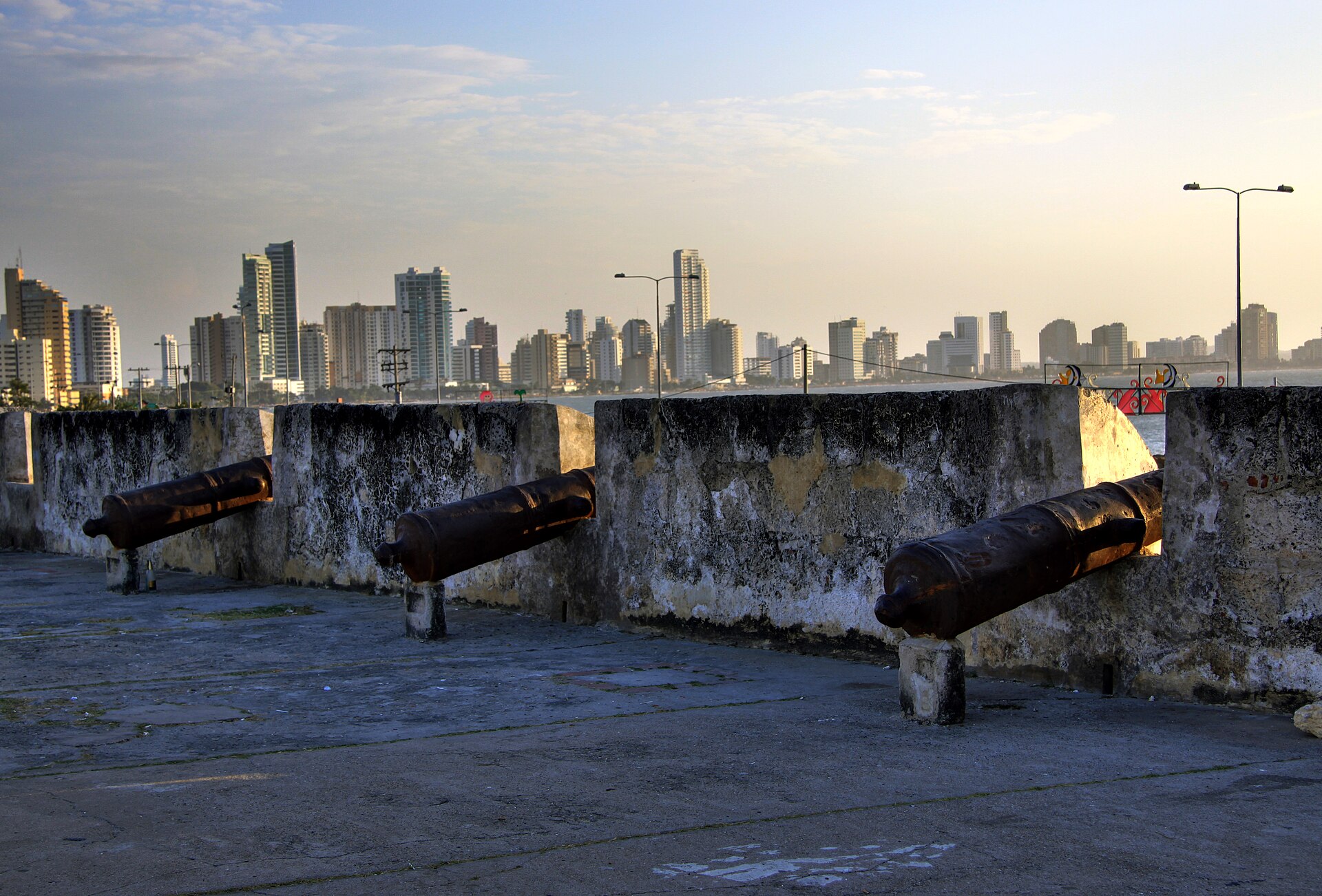
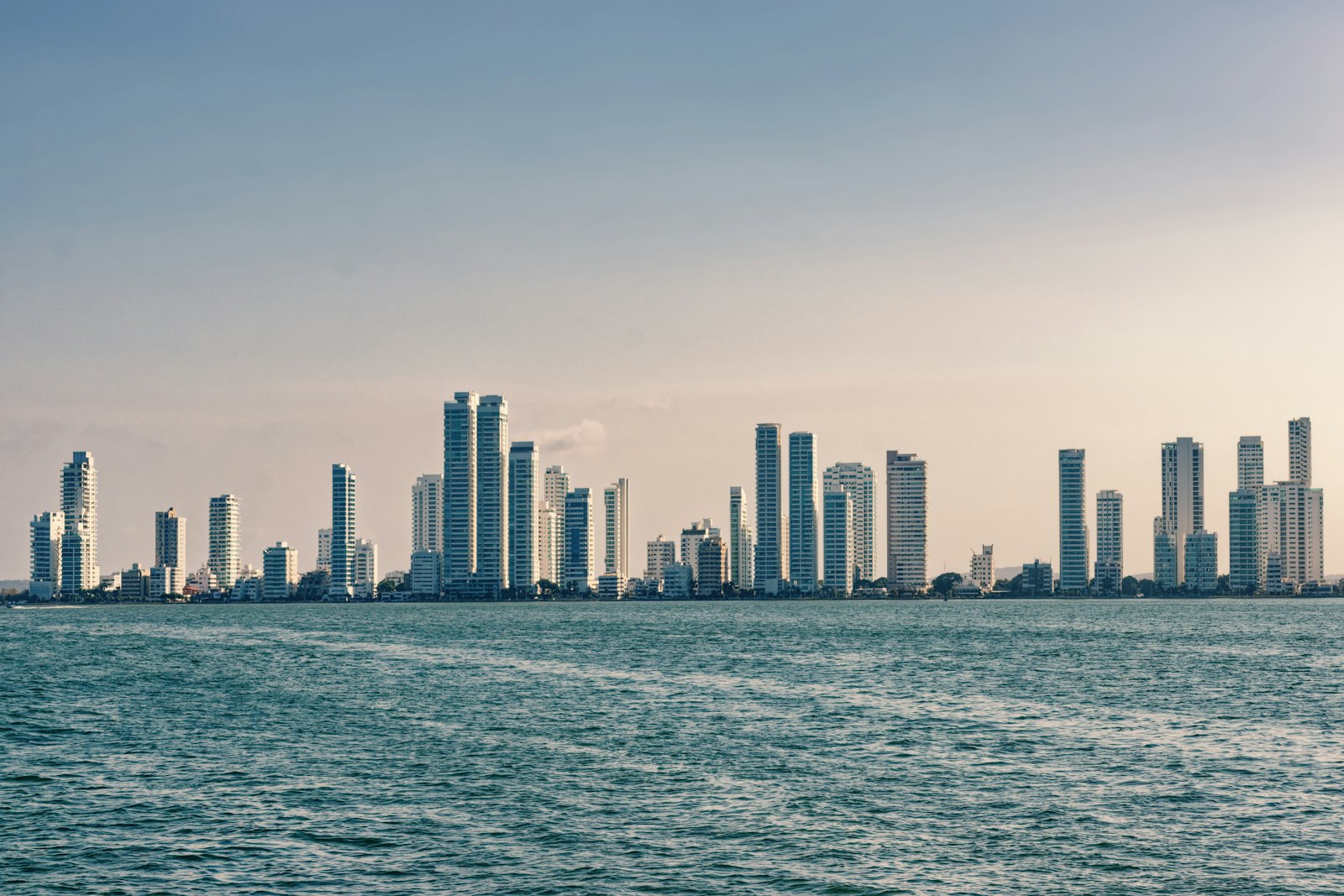
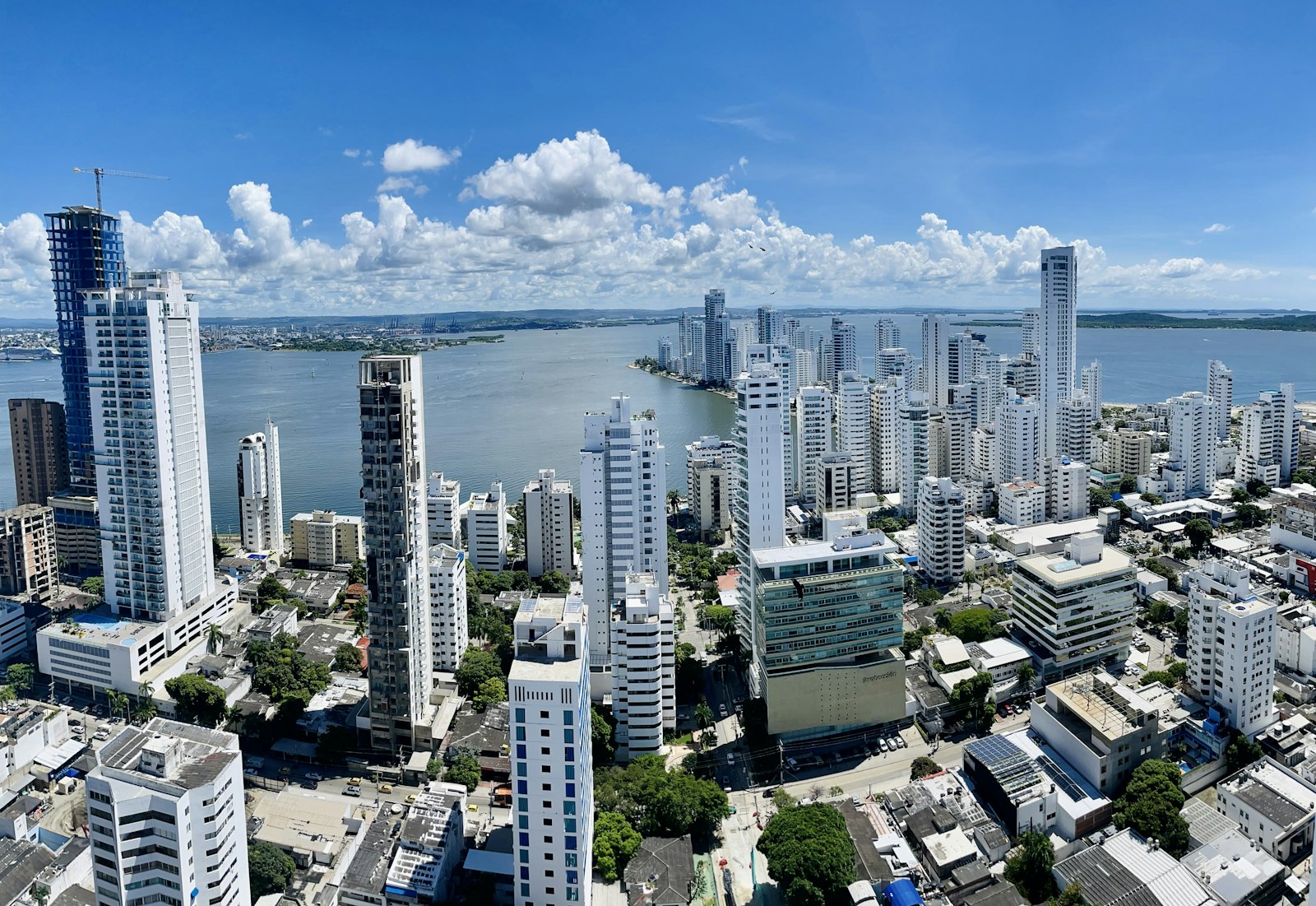
Bocagrande’s towers are visible from the city walls, from the San Felipe Castle and from any boat crossing the bay. These are the tallest on the peninsula:
- Hotel Estelar Cartagena de Indias (Cra. 1 #11-116): 202 m and 52 floors; completed in 2016, it is Cartagena’s tallest building and the second tallest in Colombia.
- Hyatt Regency tower (Cra. 1 #12-118): 190 m and 44 floors, at the entrance to the neighborhood.
- Grand Bay: 170 m and 42 floors (2010), one of the first big residential towers.
- Portomarine: 162.5 m and 41 floors (2021).
- Palmetto Sunset, in El Laguito: 146 m and 42 floors (2017).
The best photo of the skyline isn’t taken from Bocagrande itself but from outside: the Old Town walls at sunset or the Castillogrande seafront promenade.
El Laguito and the Hilton: from fishing village to hotel
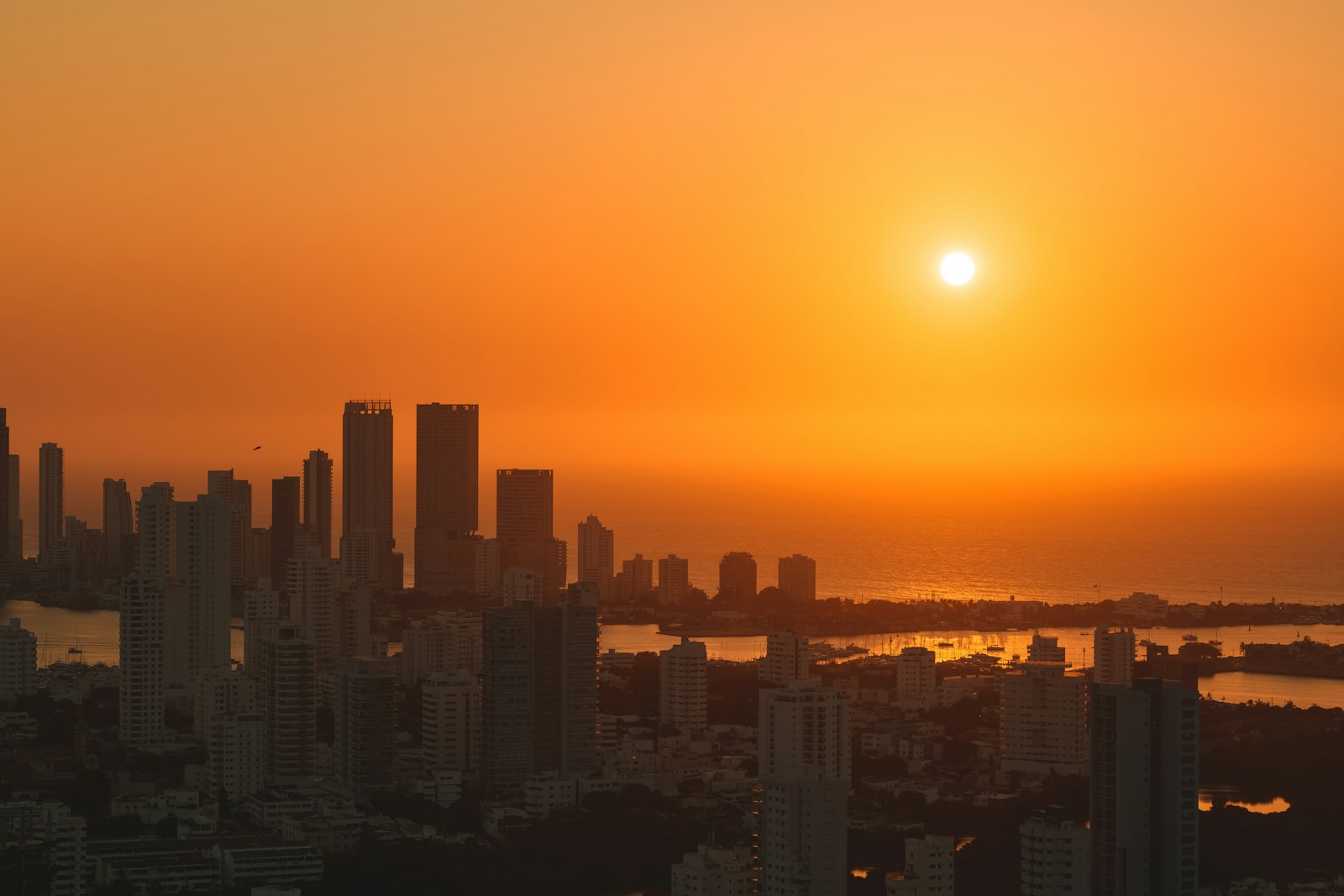
Around 1925, according to local chronicler Alberto H. Lemaitre, the end of the peninsula held nothing but a fishing village of palm-thatched, wattle-and-daub houses, right where the Hilton stands today. Villagers celebrated the Feast of the Immaculate Conception every December 8 with brass bands. When the Andian National Corporation, the U.S. oil company that bought the peninsula for 25,000 pesos, developed the area, many families moved to Tierrabomba. Today El Laguito wraps around a small lagoon where, at sunset, you’ll see fishermen casting nets and kids flying kites: the perfect end to this walk.
Perpetuo Socorro church and the St. Josemaría garden
Bocagrande’s parish church is at Cra. 5 #7-122, on the bay side. It’s a modern building that many visitors choose for photographing the skyline. For decades it was led by Father Jesús María Cano, a beloved local figure who also founded the Santa María del Mar parish in El Laguito and died in June 2025 at age 93. Next to the church, a bayside garden dedicated in 2003 to St. Josemaría Escrivá offers one of the best views of the Old Town, Manga and Castillogrande. Check Mass times with the parish before going in.
Hernando Pereira’s Palenquera statue
Hernando Pereira’s sculpture of a palenquera fruit seller with her bowl of fruit used to welcome visitors on the Paseo del Pescador, at the entrance to Bocagrande. It was removed during roadworks, and in January 2023 palenquera women protested to demand its return; we found no confirmation that it has been reinstalled. If you want to see a tribute to the vendors from San Basilio de Palenque, ten minutes away is the giant palenquera in Parque de la Marina, over 8 meters tall and unveiled on January 12, 2025.
What are Bocagrande’s main streets?
- Carrera 1: the beachfront road, home to the Hotel Caribe, the Estelar, the Hyatt and the InterContinental; this is the street for strolling and sunsets.
- Avenida San Martín (Carrera 2): the shopping spine. According to the account published by El Universal, the original plans sent to Chicago called for six lanes; a local board cut them to two, and the avenue was only widened to four some 65 years later.
- Carrera 3: the parallel street on the bay side, with classic restaurants such as the Árabe Internacional (1965).
- Carrera 5: home to the church and the bay edge, quieter and more residential.
- Paseo del Pescador and Avenida Santander: the way in from the Old Town. Since July 2026 there is a third inbound lane toward Bocagrande opposite the Calle 33 wall gate.
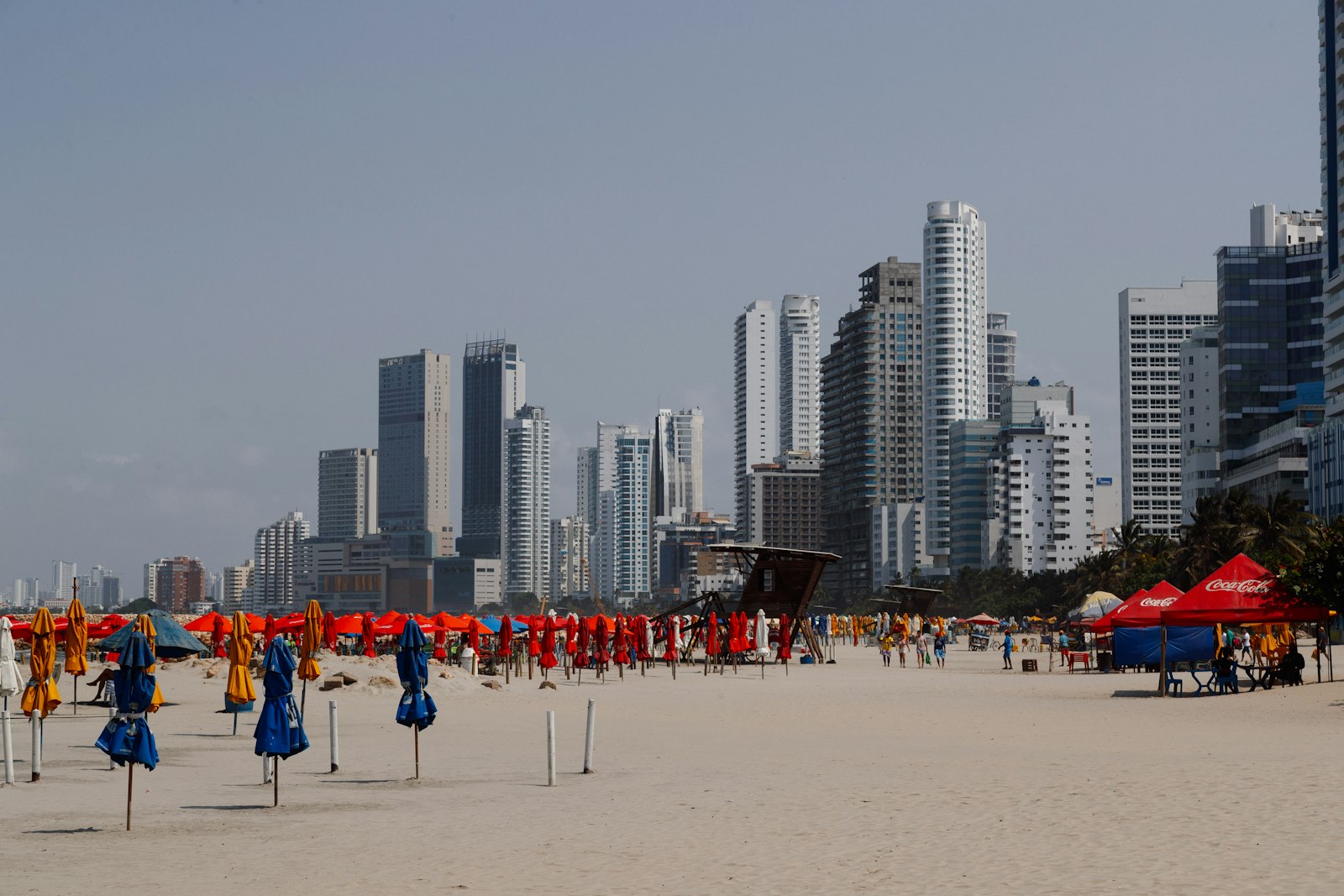
How do I explore Bocagrande on foot? Suggested walking route
- Neighborhood entrance (Paseo del Pescador): start early by the bay, where the Palenquera statue used to stand.
- Hyatt Regency and Hotel Estelar (Calles 11-12): stand at their feet and look up: these are the city’s two tallest buildings.
- Perpetuo Socorro church (Cra. 5 #7-122): cut across to the bay along Calle 7 and step into the garden for the Old Town view.
- Avenida San Martín: head back along the shopping street; a good moment for a fresh juice.
- Hotel Caribe (Cra. 1 #2-87): walk down Carrera 1 to the 1945 tower.
- El Laguito: finish at the lagoon and the point facing Tierrabomba, right above the undersea wall and the sunken fort. If you go in the afternoon, reverse the route to arrive here at sunset.
For food along the way, see our list of where to eat in Bocagrande; for beaches and where to stay, our complete Bocagrande guide. Hungry for more history? Continue with the streets of the Walled City.
What should I watch out for when exploring Bocagrande?
- Heat: temperatures often top 30 °C (86 °F). Walk before 10 a.m. or after 4 p.m., with water and sunscreen.
- Rain: October and November are the wettest months, and streets flood in heavy downpours. Wait for the water to drain.
- Roadworks: the anti-flooding project in Bocagrande and Castillogrande (31% complete in September 2026) keeps detours in place on Carrera 3, Calle 10 and Avenida Chile.
- Private property: hotels and residential towers have security; take photos from the street and ask before going in.
- Street vendors and self-appointed “guides”: if someone offers to tell you the area’s history or sell you a tour, agree on the price first or say a firm “no, gracias.”
- Taxis: there are no meters; agree on the fare before getting in (minimum COP 12,250, plus a COP 1,100 night surcharge). Emergencies: 123.
More tips in our guide Is Cartagena safe?
FAQ: what to see in Bocagrande
What are the must-see landmarks in Bocagrande?
The 1945 Hotel Caribe, the Carrera 1 skyscrapers (the Hotel Estelar is 202 m tall), the Perpetuo Socorro church with its bayside garden and El Laguito at sunset, facing the 18th-century undersea wall.
Can I visit the Hotel Caribe if I’m not a guest?
The facade is freely visible from Carrera 1. Access to the gardens and common areas depends on hotel policy; ask at reception or book a table at one of its restaurants.
What is the tallest building in Cartagena?
The Hotel Estelar Cartagena de Indias in Bocagrande: 202 meters and 52 floors. It’s the second tallest in Colombia, followed locally by the Hyatt Regency tower at 190 meters.
What is the Bocagrande undersea wall?
A submerged breakwater of piles and stone built between 1768 and 1778 by Antonio de Arévalo to close the Bocagrande channel to enemy ships. It still lies underwater between El Laguito and Tierrabomba.
Can I see the sunken San Matías fort?
No. Its remains lie about six meters deep and Dimar is studying them as underwater heritage; there are no visits or authorized dives.
How long does it take to explore Bocagrande?
Two to three hours on foot with stops. Pair it with a morning at the beach or finish at El Laguito for sunset.
Sources
- El Universal: the undersea wall that keeps Bocagrande afloat (06/24/2023, Spanish)
- El Universal: a castle under the sea in Cartagena (03/02/2025, Spanish)
- El Universal: Bocagrande, an unknown history (2020, Spanish)
- El Colombiano: the Hotel Caribe’s oldest guests (2011, Spanish)
- El Tiempo: the Hotel Caribe turns 70 (2015, Spanish)
- El Bolivarense: history of the Hotel Caribe (Spanish)
- Successful Meetings: Hotel Caribe by Faranda Grand listing (address and 2025 renovation)
- Wikipedia: List of tallest buildings in Cartagena and Hotel Estelar
- El Universal: Father Jesús María Cano dies (06/06/2025, Spanish)
- Romana: A stone in Cartagena of the Indies (2003)
- Wanderlog: Parroquia Nuestra Señora del Perpetuo Socorro
- El Universal: palenqueras demand their monument back (01/13/2023, Spanish)
- Pulzo: the giant palenquera in Parque de la Marina (2025, Spanish)
- Universidad Tecnológica de Bolívar: opening of the Bocagrande Hospital (1956)
- El Universal: new lane between the Old Town and Bocagrande (07/09/2026, Spanish)
- El Universal: anti-flooding works in Bocagrande (09/14/2026, Spanish)
- El Universal: 2026 taxi fares and 2026 Transcaribe fare (Spanish)


